Chemistry is easy to recognise. The pull, the nerves, the sense of being drawn towards someone before you can say why. It is real, and it matters.
But chemistry is not what makes a relationship feel good to live inside. Years in, what counts is something quieter: how two people handle being wrong, how they repair after a hard conversation, and whether each of them wants to understand the other.
That is emotional maturity. It isn’t perfection, and it isn’t never arguing. It is two people who can face themselves, hear something hard, and keep turning towards each other. To me, that is what makes someone emotionally hot.
Why the same arguments keep coming back
Every couple brings two histories into one relationship. The way each of us was loved, or not, shapes what feels reassuring, what feels threatening, and what we reach for when things go wrong.
That is often why the same argument keeps returning. It is rarely only about the dishes or the phone. Underneath, one person may be asking “do I matter to you?” while the other is asking “can I get this right?”
In my work, I notice how often the things couples clash over began long before they met. Understanding that doesn’t excuse anything. It changes the conversation.
Eight qualities worth looking for, and growing
1. Facing yourself. Being able to notice your own part in things without collapsing into shame or rushing to defend. Harshness towards yourself is not the same as self-awareness.
2. Hearing a difficult truth. Defensiveness is usually protection. If being wrong once came with coldness or criticism, the body learns to brace before the mind has heard the words.
3. Curiosity about your own behaviour. Blame is quick. Curiosity is slower. It asks “why did I react like that?” and is willing to wait for an answer.
4. Apologising well. “I didn’t mean to” is often true. It just isn’t the whole apology. A good repair stays with the impact, not the intention.
5. Sitting with discomfort. Feeling jealousy, hurt or uncertainty, and being able to name it, without making someone else responsible for making it go away.
6. Questioning old beliefs. We all inherit ideas about love, family and worth. Questioning them isn’t disloyalty. It is choosing which ones to keep.
7. Vulnerability without losing power. For many of us, needing nothing felt like the safer option. Vulnerability asks us to be seen needing something, and to stay.
8. Wanting to understand. Curiosity about the other person’s inner world, not only a wish to have your own seen.
None of us has all eight all the time. Each of us has qualities that come easily and others that are still forming. That is the point. Emotional maturity is something you practise, not something you arrive at.
It begins with you
How we love each other usually begins with how we relate to ourselves. The way you speak to yourself when you get something wrong is often the way you brace for others to speak to you. The more room you have for your own mistakes, the more room you tend to have for someone else’s.
So the question isn’t only “is my partner emotionally mature?” It is also “which of these do I find hardest, and where did I learn that?”
A guide for couples
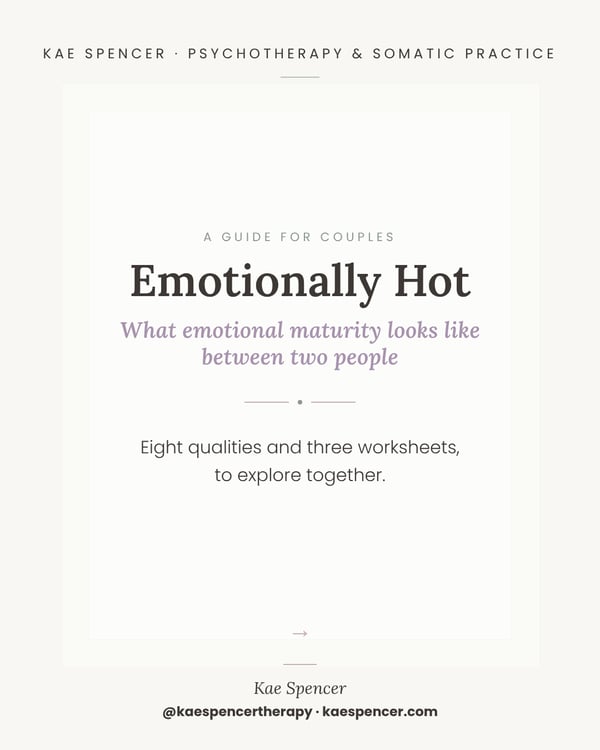
If you’d like to explore these qualities together, I’ve written Emotionally Hot: A guide for couples. Each quality goes further than this post: what it looks like, what it isn’t, a question for each of you, and one to talk about together. It ends with three worksheets: what I need from you, what I can offer you, and a conversation page to bring it together.
It is designed for an unhurried hour, two pens and a willingness to listen.
If something here stayed with you and you’d like to explore it more deeply on your own, you’re welcome to get in touch.
This post is for reflection and education. It isn’t therapy or couples counselling. If you feel afraid of your partner, or controlled, please speak to your GP or a support service such as Samaritans on 116 123.


